Meet what is present.
Notice sensations, emotions, and impulses with enough support and choice. A feeling can be present without requiring immediate action.
ONE PERSON. MANY DIMENSIONS.
“What if healing and inner freedom are profoundly related, but not the same thing?”
WESLEY KRESS
Physical health, emotional pain, and the way we experience life can influence one another. They also deserve attention in their own right.
My approach brings individualized clinical care together with an exploration of the patterns, perspectives, and relationship with yourself that shape your experience. This may include noticing how you respond to discomfort, what happens when you feel vulnerable, or how familiar protective responses appear in your body, thoughts, and relationships.
Understanding these responses can be valuable. The work also makes room to experience them directly, at a pace that respects your comfort and choice.
Here, inner freedom includes exploring a less compulsory relationship to learned identities, roles, and outcomes. For those interested, this can extend to inquiry into the felt sense of a separate self. Regulation, emotional integration, and contemplative inquiry have distinct purposes. They can inform one another without guaranteeing the same changes.
THE RELATIONSHIP BENEATH HEALING
Someone can become remarkably skilled at regulating, understanding, and containing difficult experiences while carrying an unquestioned conclusion from earlier adversity: “There is something fundamentally wrong with me.” If each uncomfortable feeling becomes another flaw to correct, the pursuit of healing may reinforce the relationship with yourself that developed in response to the wound.
Fear, shame, fragmentation, or disconnection can sometimes reflect protective adaptations to experiences that felt overwhelming. Their emergence does not mean you are defective. They can be met with curiosity, appropriate support, and choice, without assuming what caused them or treating emotional intensity as evidence of progress.
Capacity helps you remain present with what you experience. Integration can change how you relate to what was previously avoided or disconnected. Contemplative inquiry, when welcomed, can go further by questioning the identity you have felt compelled to fix or defend. These possibilities are distinct, not required stages or guaranteed outcomes. Physical health, relationships, and practical circumstances still deserve appropriate care.
You can care for everything that was hurt without treating yourself as fundamentally broken.
PRIOR LEARNING / PRESENT EXPERIENCE
Prior experiences can become encoded as learned expectations and habits, sometimes without a clear autobiographical memory. This does not mean an emotion is literally stored in a tissue or that a sensation reveals a hidden event.
Predictive processing is a scientific framework in which the brain uses prior learning alongside incoming information to anticipate and interpret experience. These predictive models can influence what feels safe, threatening, or possible. They are not a complete explanation of every response or condition.
Perceived safety and actual safety are related but distinct. Something unfamiliar may feel threatening in a supportive setting; feeling calm does not establish that a situation is safe. We attend to your present circumstances as well as your response.
Learning from what has happened before.
Anticipating what a situation may mean or require.
Interpreting present cues in the body and the world.
Notice sensations, emotions, and impulses with enough support and choice. A feeling can be present without requiring immediate action.
Communicate a need, set a boundary, receive support, or try a manageable movement. Expression can be quiet and deliberate.
A different experience may offer information that revises an expectation over time. We review what helped and what remains difficult, rather than assuming a pattern has changed.
An illustrative framework, not a required sequence or a validated model of this treatment. Present conditions, physiology, relationships, and practical support influence every part of the picture.
Feeling and expression can complement one another. For example, noticing guilt while choosing a reasonable boundary may offer a different experience from automatically agreeing. Sometimes making room for a feeling is useful; sometimes communication, action, rest, or a change in circumstances matters more.
Neither avenue is always necessary or sufficient. Emotional intensity, catharsis, and retelling the past do not establish new learning. We do not require emotional release or promise permanent rewiring. The aim is greater flexibility in daily life, with room to pause or change direction.
Scientific context: Barrett, 2017: a predictive account of emotion ↗. This theory informs the explanation; it does not validate this complete clinical approach or guarantee an outcome.
A HYPOTHETICAL CLINIC EXAMPLE
Imagine someone living with persistent pain, disrupted sleep, and a demanding workload.
They understand that recovery matters. Yet when they consider resting, their shoulders tighten, guilt appears, and they feel an urge to keep working.
We attend to the physical concerns, sleep, workload, and available support. If they wish, we can also explore what happens around rest.
Understanding the expectation. What does stopping seem to mean? Perhaps they notice a familiar belief: “If I am not useful, I am letting people down.”
Meeting the experience. What happens as they consider taking a break? We may notice tension, emotion, thoughts, and impulses without deciding in advance what caused them.
Exploring a different response. A manageable next step might be communicating a limit, accepting help, or allowing a brief pause while noticing the response.
Reviewing what happens. Does the change help? What remains difficult? Do the physical symptoms, daily function, and emotional experience change in different ways?
This is how understanding, direct experience, and practical action can work together. The aim is to make more choice available in everyday life.
This hypothetical example illustrates the approach. It is not a patient account or an explanation of what caused the person’s pain.
THE BIOLOGY OF LIVED EXPERIENCE
Human physiology develops within the context of the lives we live. Prolonged childhood adversity can influence stress-response systems and is associated with an increased likelihood of certain autoimmune diseases later in life. Genetics, infections, environmental factors, and other physiological processes also matter. These influences are not mutually exclusive.
My own history led me to take these connections seriously. I believe early adversity contributed to my autoimmune health challenges, and I experienced meaningful improvements alongside emotional integration. That personal chronology does not establish a specific cause, prove that emotional inquiry reverses autoimmune disease, or predict someone else's outcome. My congenital thyroid disorder continues to require medical care.
Understanding these relationships means neither separating emotional experience from the body nor reducing every physical condition to unresolved trauma.
Research: 2025 systematic review of childhood adversity and autoimmune disease ↗BODY & EXPERIENCE
You may understand a pattern and still notice tension, emotion, or an impulse arriving before a different response feels available. Attention to present experience can add something to reflection, alongside appropriate physical care.
Thinking can help you understand, organize, and act. We can also notice when repeated analysis is taking you further from what you feel or need. Thoughts and bodily sensations are both part of the inquiry; neither provides an unquestionable interpretation.
We notice what happens without deciding in advance what it means. A sensation does not prove a hidden memory or establish the cause of a physical condition.
UNWINDING
Unwinding is a practical term for gently exploring familiar patterns such as bracing, pleasing, performing, withdrawing, or needing control. We notice sensations, thoughts, emotions, and impulses without requiring a hidden story or treating protection as an enemy.
Emotional integration may mean recognizing a response sooner, allowing a feeling, setting a boundary, or finding more choice in daily life. Physical concerns continue to receive appropriate assessment and care.
UNBECOMING
A feeling or situation can arrive with a familiar conclusion about what you must do or who you must be. Someone is disappointed, and you feel you must make it right. Uncertainty appears, and you feel compelled to find an answer immediately. An uncomfortable feeling arrives, and allowing it seems impossible.
We can attend to what is happening now: the sensation, emotion, thought, impulse, and circumstances. When useful, we can also explore what seems to be at stake about you.
Being capable, caring, organized, or ambitious can remain meaningful. Unbecoming explores whether these capacities must secure your worth or belonging, or protect you from uncertainty and discomfort. The possibility is more choice, including recognizing when another response or practical change is needed.
Explore learned identity & contemplative inquiryIN THE SESSION
Your concerns and goals guide the session. Conversation and attention to present experience may accompany physical care, movement, acupuncture, or other appropriate tools. A focused approach may be enough; some sessions remain centered on rehabilitation or performance.
You can ask questions, pause, decline an exploration, or keep the focus on physical concerns. You do not need to recount your history, produce a release, or explore identity. There is no required sequence and no separate emotional-integration booking.
EVERYDAY INTEGRATION
Bringing the work into daily life may involve communicating a need, accepting support, approaching movement, or making room for uncertainty. Your personalized post-session summary and guidance can help connect an observation with a manageable next step.
We review what helped, what did not, and what needs to change. This is individualized, not a standard homework requirement. Emotional intensity is not a measure of integration, and greater flexibility does not require constant calm.
DIALOGUE & FEEDBACK
You can tell me when an explanation does not fit, an exploration feels unhelpful, or something is not changing. Your feedback helps us understand what to continue, adjust, or approach differently.
My role is to listen, assess, and work with you toward an appropriate next step. That may include changing the plan, coordinating with another professional, or recommending further care. You do not have to agree with an interpretation or disclose more than you want.
CONTEXT & PRACTICAL SUPPORT
Exploring your responses does not make every difficulty an internal problem. Workload, relationships, physical illness, and access to support also deserve attention.
Sometimes the next step is noticing a familiar pattern. Sometimes it is reducing a demand, setting a boundary, receiving help, or changing a practical condition. Acceptance can support clear action without requiring agreement with what is happening or consent to preventable harm.
INNER FREEDOM / ORDINARY LIFE
Wholeness, as I use the term, points toward a less compulsory relationship to the person you feel you must be. Your history, personality, relationships, and responsibilities remain meaningful without having to settle every question of your worth.
We can think about ourselves without requiring every experience to revolve around that representation. You can pursue change without requiring each improvement to finally make you enough. Health, relationships, and practical circumstances still deserve care.
This is a direction of exploration, not a state I can promise. Its relevance is considered in everyday life: how you respond, communicate, receive support, maintain boundaries, and care for what matters.
ORDINARY SITUATIONS / POSSIBLE QUESTIONS
These are hypothetical examples, not interpretations we assign to you. A response may be appropriate to your circumstances, and a different question may be more useful.
“I can relax only when everything is finished.”
What does unfinished work seem to mean or require of you?
“I understand the pattern, but I keep doing it.”
What happens in the moment when the familiar response returns?
“I’m comfortable helping, but uncomfortable receiving.”
What is accepting support like for you? Receiving care may feel unfamiliar when you are accustomed to being the person who helps. You do not have to explore this for treatment to work.
“I need to know what will happen before I can move forward.”
What is uncertainty like for you, and what would help you take an appropriate next step?
FOUR DIMENSIONS OF CARE
Physical condition: What needs evaluation, treatment, rehabilitation, or referral?
Function: What can you do, tolerate, and participate in?
Lived experience: What is living with this like for you?
Identification: How does this become a statement about you, something you must control, or an experience that seems to define you?
These dimensions interact, but they do not always change together. You might move more comfortably while still feeling apprehensive, or experience less distress while continuing to need medical treatment. Physical recovery, lived experience, and inner freedom deserve attention in their own right.
We consider what may have contributed earlier, what appears relevant now, and what still needs care if a contributor changes. A change in one dimension does not establish the original cause of a condition.
FOUR WAYS OF KNOWING
The four dimensions of care describe what deserves attention. These four ways of knowing describe how we investigate it. This is an organizing framework, not a validated assessment or a required sequence.
Measurement: What can history, examination, relevant evidence, and appropriate testing tell us about your condition and function?
Relationship: What becomes visible between us through dialogue, context, and feedback? We also attend to whether there is trust, openness, mutual respect, and room to disagree or set boundaries.
Direct experience: What do you notice from within, including sensations, emotions, thoughts, and impulses?
Contemplative inquiry: If you wish to explore it, who or what is aware, and how is identity being understood?
Each perspective has a distinct question and a distinct kind of evidence. A felt insight is not a medical test, and a clinical finding does not settle a contemplative question. We return to what is useful, appropriate, and relevant to your care.
A PHENOMENOLOGICAL TEACHING MAP
Three orientations to explore in present experience, rather than stages to complete or a hierarchy for ranking people.
Attending to experience.
Seeing, hearing, sensing, feeling, and thinking are occurring. Here, the invitation is to notice experience without immediately elaborating what it says about you.
Representing ourselves.
We can understand experience in relation to our body, history, roles, plans, and responsibilities. This capacity helps us reflect, anticipate consequences, maintain relationships, and act responsibly.
Sometimes reflection becomes repetitive self-evaluation: How am I being perceived? What does this mean about me? What must I do to remain safe, acceptable, or in control?
A different relationship.
Wholeness, as I use the term, points toward less compulsory identification with these representations. Reflection, memory, personality, boundaries, and responsibility can remain available without every experience needing to become a statement about who we are.
The possibility is more flexibility in how these capacities are used, with attention to how that flexibility is lived.
This is not a return to a time before self-awareness. The capacity to reflect remains useful; responses that feel compulsory may become more flexible. This contemplative teaching framework is not an established developmental sequence or a promised endpoint. It does not determine what someone should experience or replace appropriate clinical care.
Unbecoming names the inquiry into who you feel you must be and the requirements attached to that identity. Wholeness describes a possible relationship in which meaningful identity and reflection need not organize every experience. Inner freedom names the broader possibility being explored, including less compulsory identification and, for some, deeper contemplative questions. These are terms within my approach, not separate stages or guaranteed outcomes.
IDENTITY & CONTEMPLATIVE INQUIRY
Some inquiry concerns the identities and roles through which we understand ourselves. Identity includes learned patterns, valued commitments, culture, belonging, and preferences. The question is whether a particular pattern remains useful or feels compulsory, rather than separating a “true self” from everything learned.
A further contemplative question concerns how the felt sense of a separate “me” appears within experience.
These questions can overlap, but they are not identical. Noticing a self-critical thought as a thought differs from exploring the sense of being a separate observer to whom experience is happening. Neither requires a prescribed answer.
Experiences in which aspects of the usual sense of self or separation diminish are sometimes described as ego dissolution. Such an experience is not a requirement or a measure of integration in this work.
This inquiry is optional and does not require adopting a belief about consciousness. Everyday functioning, boundaries, discernment, and responsibility remain important.
Explore how reflection and present experience work together ↑
REGULATION & CAPACITY
Regulation concerns your capacity to meet sensations, feelings, and daily demands while retaining some flexibility and choice. Depending on your needs, the work may begin with physical care, movement, orienting to your surroundings, or noticing what feels manageable.
The aim is not constant calm. You can pause, decline, or change direction. Greater intensity is not evidence of progress, and this work does not use deprivation, forced emotional release, or overwhelming discomfort to pursue insight.
AN ILLUSTRATIVE MODEL
There are several possible directions when a familiar response appears. These prompts are invitations, not steps to complete.
You can move between these possibilities or stop. Intensity may increase, decrease, or stay the same; it does not measure progress. This is a teaching aid, not a medical mechanism or a promised outcome.
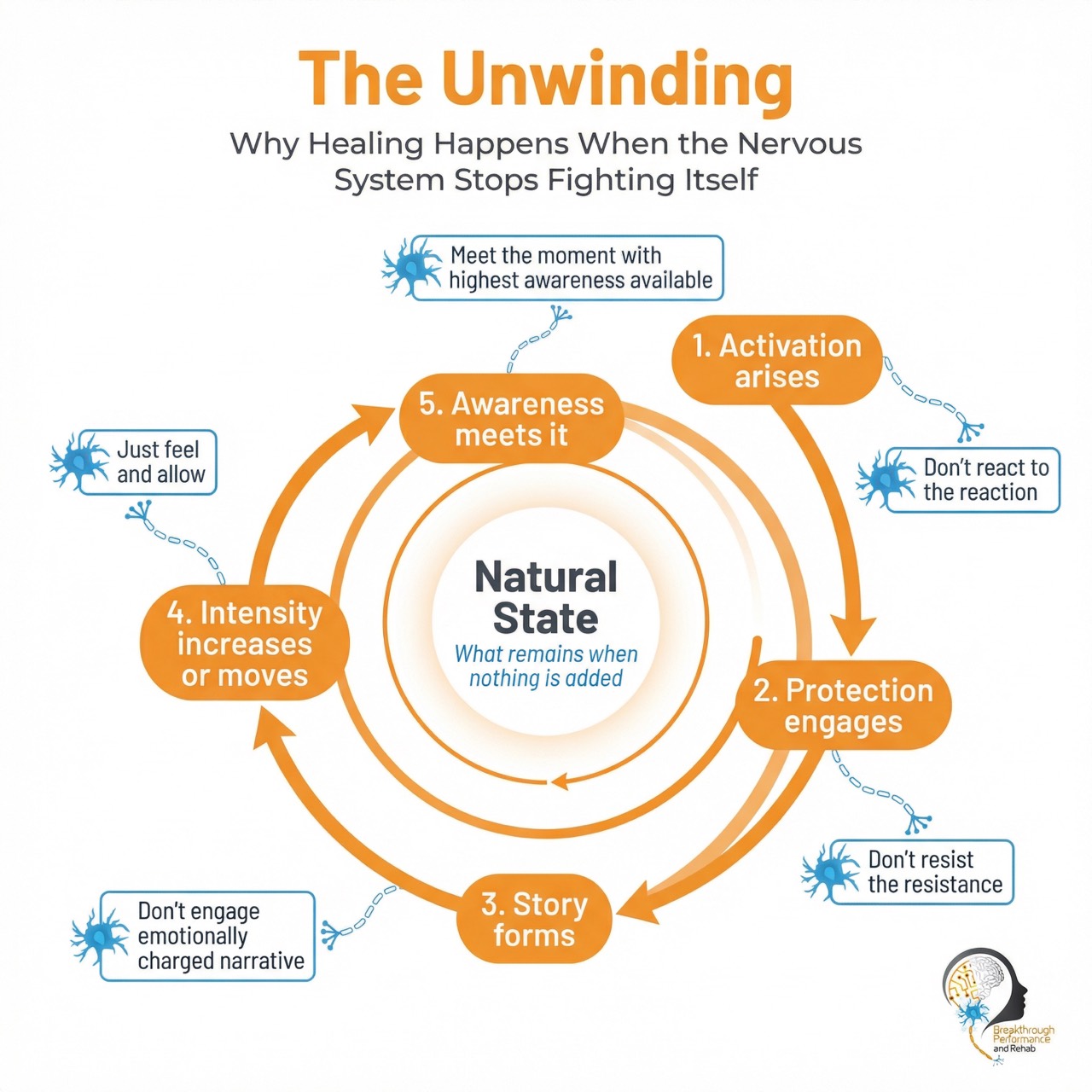
The image’s language about healing and a “natural state” is a reflective metaphor, not a medical mechanism or a promised outcome. Allowing experience does not mean pushing through pain, ignoring symptoms, or staying with overwhelming activation. Intensity may increase, decrease, or remain unchanged; increased intensity is not evidence of progress. Pausing, orienting, moving, and seeking appropriate support remain available. This model concerns unwinding and does not establish contemplative realization.
View the original graphic at full size ↗The title is “The Unwinding,” with the subtitle “Why Healing Happens When the Nervous System Stops Fighting Itself.” Five orange stages form a circular flow: 1. Activation arises. 2. Protection engages. 3. Story forms. 4. Intensity increases or moves. 5. Awareness meets it.
Prompts around the cycle read: “Don’t react to the reaction,” “Don’t resist the resistance,” “Don’t engage emotionally charged narrative,” “Just feel and allow,” and “Meet the moment with highest awareness available.” The center reads “Natural State” and “What remains when nothing is added.” These are the graphic’s reflective terms, interpreted with the context above.
This work is offered within Wesley’s integrative clinical approach. It is not presented as psychotherapy or trauma treatment, or as a substitute for indicated medical or mental health care. There is no promised awakening, permanent state, or required destination. If a practice worsens distress or functioning, pause and seek appropriate assessment rather than treating deterioration as progress.
Research connects bodily awareness and regulation with aspects of emotion and self-experience. Experimental studies have also shown that aspects of bodily self-experience can change when sensory information is manipulated. This offers context for attending to bodily experience; it does not establish a single cause of illness or show that this particular clinical approach produces a contemplative outcome.
The connection to identification and contemplative inquiry is an interpretation and a direction of exploration. Research findings, teaching models, personal experience, and clinical decisions answer different questions.
These sources provide scientific context. They do not validate the complete teaching framework or establish that emotional inquiry treats a particular disease.
WORKING TOGETHER
This work is offered as part of Wesley’s integrative clinical approach. It is not presented as psychotherapy or a substitute for indicated medical or mental health care. Psychotherapy encompasses many approaches; this page describes how Wesley works rather than making a comparison with every form of therapy.
No. Your needs, comfort, and agreement guide the session. You can pause or decline an exploration. A session may focus on rehabilitation, performance, or other relevant physical concerns.
No. Book the same integrative session. The tools and emphasis are determined together, according to what is relevant to you.
One integrative 60-minute session, with space for your needs and goals.
Start or Continue your JourneyExplore acupuncture & nervous system responsesReturn to the session experience